Wednesday, November 21, 2012

Christopher Isherwood's Last Volume of Diaries: Liberation

And so it happens that we come to the last of what has been the greatest diary reading of my literary life.  Christopher Isherwood's diaries are (and I am intent to NOT use a qualifier) the best literary diaries written in the 20th Century (yes, Virginia Wolff's included).  I am so unapologetic about my enjoyment of these volumes that I am willing to bet a great deal many people agree with me; unfortunately, the "many people" do not seem to include the NYT's book reviewers.  While it is not a surprise I am clashing once again with the powers of the NYT, this time (as opposed to the times when I defend Paul Auster's work), I am challenging any reviewer at the NYT to argue differently.

Christopher Isherwood's "Liberation," the third and last part account of a literary genius, begins as Isherwood welcomes the new decade (1970s) with the same type of foreboding yet full of enthusiasm--a paradox that is his and his alone.  The details included in "Liberation" follow the same pattern of Hollywood gossip, literary and movie producing heartache, sexual practices down to the most minute (weight recording) detail of life.  There are many of the same cast of characters I've grown to love and/or hate, and new ones that seem so transient it almost feels like Isherwood is talking about ghosts.  Along with the passage of the years, Isherwood records the passage of time with all of his health aches and that of others as well.  It is particularly sad to read when characters such as Caskey pass away--his case (dying alone in his apartment in Athens) strikes me as the worse of all the others.

Don Bachardy is steadfast in his love and support of Isherwood as the writer becomes increasingly unable to deal with his health problems.  Not without its growing pains, their relationship reaches a level not commonly seen in relations where the age difference is so great.  Both men face the future with courage as the inevitable was a matter of time and they both knew it.  Isherwood is particularly open about how strong Bachardy faces each and every one of Isherwood's increasingly debilitating illnesses.  Their collaboration (especially in the screenplay of "Frankenstein: The Real Story") is as strong as ever throughout the 1970s and 1980s, alongside Don Bachardy's own "liberation" as an artist begin recognized on his own talent and not just for being Isherwood's partner.

The title "Liberation" refers to Isherwood's own, but also to the entire gay liberation movement.  After the publication of "Christopher and His Kind," Isherwood established himself the elder statesman (or grand dame) of the gay movement during the mid to late 1970s.  Isherwood is candid in his views, not always agreeing with the political branch of the movement, and other such necessary differences when dealing with people of genius.  There are references to speeches and interviews, but to list them here would be somewhat of creating a catalog when in reality none is needed if you are to read the volume entirely.

The sadness of getting older, and, as a result, weaker in health is put down on paper here as the chronicle of a life well lived, albeit the hope for more and more years.  Isherwood is revealing in his faith and refers to his guru quite frequently during this time.  Despite the fact that after the death of his guru Isherwood stayed away from the Vedanta center doesn't seem to affect Isherwood's spirituality.  Yet, as in all tasks that demand unshakable discipline, he finds himself thinking he's lazy for missing a day or two of japam, or simply because he's tired of it all.  In all of this, Isherwood's relationship to Bachardy comes as the main source of comfort for the writer.  Isherwood explicitly elaborate on their daily life, a life that even though devoid of some of their activities in earlier years, seems to generate more tenderness and togetherness.

Despite the abrupt ending of the diaries (Isherwood died in 1986 but by 1983 he had become weak and unfocused to continue in a manner satisfactory to his earlier work).  I feel a sense of void, really, a big sense of having finished these massive volumes and having learned a great deal from them.  It's not always that one finds something that is both engaging and entertaining.  I have them to my left on the book shelve and look at their spine with a strange sense of nostalgia, as if I had come to befriend Isherwood and Bachardy and shared their extraordinary lives.

Labels: , , ,

Wednesday, August 08, 2012

Christopher Isherwood -- Lost Years, A Memoir 1945-1951

Before I get to the source of why Isherwood's diaries are so addictive to read, I must point out that the art of  writing daily entries on a journal is making a comeback.  Whether or not this has anything to do with Isherwood is irrelevant.  I've read Christopher Isherwood's diaries (Volume 1, 1939-1960 & Volume 2, 1960-1969) which together add up to 1,900 pages, and my fascination with his life and the lives of those around him became almost obsessive.  Actually, I should point out clearly that the diaries ARE addictive and there's no way to stop reading them once you begin.  Of course I know what drives this addiction, but I am quite ashamed to admit it here*.

Lost Years - A Memoir, 1945-1951 is written in narrative form because Isherwood did not keep a lengthy entry journal but rather just a "day-to-day-one-entry-at-a-time," and these entries only covered people, places visited and travels.  As a result, the narrative reads like a story and Isherwood treats himself as a separate--a strange third person point of view that comes and goes and takes a bit of time to get used to.  The other fascinating part of it is the lengthy footnotes that Isherwood includes as side notes (they are so long that they turn into their own little stories within story).  The explicitness of the sexual escapades Isherwood engaged in are clearly forewarned by Katherine Bucknell in her excellent introduction.  I wasn't so much turned off by these as I was curious as to why he had to include them.  Nevertheless, the intricate liaisons and relationships are simply amazing to follow.  Capote, Garbo, Agee, Angermayer, the Huxleys, Thomas & Klaus Mann, Tennessee Williams, and so many others that appear on both the first and second volumes are some of the characters that come in and out of Isherwood's life.  The travels alike are both numerous and laid down in amazing detail (for someone reconstructing from memory).

It's a great memoir, really, and even if you are not an Isherwood fan, you should really pick it up because it's also an instruction manual on how to keep (or reconstruct from memory) a great personal journal.  As Martin Rubin from the Washington Times observed: "[Isherwood] is quite simply a marvelous diarist, one of the very best in the long tradition of English diarist starting with Samuel Pepys."  I couldn't agree more.

* Every turn of the page is a delicious piece of gossip (Hollywood and other).

Labels: ,

Thursday, December 02, 2010

The Sixties - The Diaries of Christopher Isherwood 1960--1969

I've owned two copies of "The Diaries of Christopher Isherwood Volume 1" in the last five years.  The first of these was a paperback edition purchased on the strength of its length--I was due for a long volume reading at the time.  Unfortunately, I "lost" my copy of Volume 1 when it suddenly disappeared from my classroom desk one day (I think some student "borrowed it" after I constantly praised it in class), and neglected finding another copy, even online.  I came to my second copy on one of my lucky trips to my used bookstore/literary "watering hole," and, as lucky can be, it was a hardcover copy! I fell in love with the Diaries from the moment I read the first page of the Introduction and didn't stop until the very end.

"The Sixties: Diaries 1960-1969" was released a few weeks ago.  Needless to say, I was at "Barnes & IgNoble's" door half an hour before they opened.  I consider it my "Harry Potter" moment every time my favorite contemporary author publishes a new book.  Presently, I am about 260 pages in and I cannot put "The Sixties" down.  In fact, I took a nap yesterday in the afternoon and ended up dreaming with the main characters of the diaries, Christopher Isherwood and Don Bachardy.  It was something really new!

"The Sixties" sees a much more mature Don Bachardy, and a not so much different than Volume 1 Isherwood.  It's very refreshing to read Isherwood's assessments of what Bachardy is going through (growing pains as an artist and as a lover).  Their love affair is so expertly detailed in the writing, as well as analyzed by the more "mature" Isherwood.  It seems to me he understands Bachardy better as the young man goes to the trials of blazing his own path.  Despite moments of real "bitchiness" (what Isherwood himself admits several times), the Sixties show are more understanding Isherwood, dedicated with renewed vigor his practice of spirituality and search for peace.  I have not seen the documentary "Chris and Don," and just found out no library in this area carries it (I wonder why!!!), but I really, really want to watch it.  Oh, the perils of living on the skirts of the Bible Belt.

So far, I have only underlined a couple of passages and they both deal with the writing craft, of which Isherwood is definitely an overlooked master of the 20th century.  The first of these stabs directly at the main problem with writing creatively.  Isherwood states: "I shall try to abstain from philosophizing and analysis, and stick to phenomena, things done and said, symptoms."  It is a sobering piece of self-advice, and what makes Isherwood so honest about it is the fact that 1) despite the fact that he was a master diarist, and 2) despite the fact that much of what is found in the Diaries crosses over (the experience not so much as the detail) to the fiction side of his writing, he sticks to this idea through and through.  Creative Writing 101: Internal monologues devoid of action do have their place in fiction, but can't hold an entire plot together all of their own (unless you are Joyce or Woolf).  The other passage was directed a "work in progress" and just as important self- advice: "Yesterday I reread my novel, the fifty-six pages I've written so far.  I am discouraged; very little seems to be emerging.  Maybe I really have to sit down and plot a bit before I go on.  I do not have a plot and I don't even know what I want to write a novel about... No, that's not quite true.  I want to write about middle age, and being an alien.  And about the Young.  And about this woman.  The trouble is, I really cannot write entirely by ear; I must do some thinking."  


My colleagues criticize my time allowance to volumes of work like the Diaries.  They think differently than I do.  I am a much slower reader (and grader, too) and it doesn't bother me one bit to find a minimal number of passages to underline (2 passages in 600 pages).  My colleagues use their time much more "intelligently," they argue.  If it's not helpful on research, it's not worth it.  Father forgive them, for they do not know what they say.

Labels: , ,

Wednesday, November 24, 2010

Reading for the Rest of the Year: Literary Fete Sauvage

I am about to embark on a literary fete savauge, away from all and mentally remote in enchanted woods.  I've only experienced this once before--my two favorite literary figures having works published close to one another. The first time it was the year in which Paul Auster and Haruki Murakami both published within weeks of each other (at that, Murakami had two books published that year).  And now this new experience... I am going to relish this, every delicious page by page... hopefully, I'll be done by December 31st because I suspect my Reading List for 2011 will not wait.

Labels: , , ,

Wednesday, September 22, 2010

Desperately Seeking Ms. Sally Bowles

If it seems like I am engaging on an Isherwood month-long, binge-reading, I would like to clarify that (in no uncertain terms) I plead guilty to said "crime." The difference, however, is the fact that I am digesting my binge completely (thank you very much), and that the clarity of the prose is the main culprit for my excesses. I simply cannot put the book down. It's the kind of book you want to have last forever--sort of the "why did James Baldwin had to go out and die and not write any more books" feeling. Good books like Isherwood's "The Berlin Stories" should last forever, not in the sense of returning to it a few years later but rather a lifelong, never ending string of prose and characters that live as long as we do. Okay, I realize I am asking for an impossibility, and, as the wise man once said, nothing good lasts forever, but the mere idea and the perfectibility of it is so amazing it might drive the sane and religious to make a deal with Satan. I know I exaggerate. What I don't exaggerate (nor do I apologize for) is Isherwood's perfect weaving of a yarn so true to life I am tempted to go on a hobo-like search for Sally Bowles and forget I have a real life with real responsibilities.

Of course, my attraction to Sally Bowles is deeply rooted in an admitted obsession with 1920s glamor, style and the characteristic "Vamp," of whom so much has been written. I know "The Berlin Stories" take place in 1930s Germany, just about the same time the Nazi machine is about to take power, yet my imagination still takes me back to the Jazz Age, and all the complexity that entails. Christopher and Sally become close after Sally's break up with a man who "betrays" her for a woman "more his type." The character of Sally Bowles, immortalized on the silver screen by Liza Minnelli in "Cabaret," is a new generation vamp, but lacking the social graces of her 1920s counterparts. She is crude, somewhat ignorant and rough in all the key edges. But what she lacks in graces she more than makes up in her ability to survive day after day, month after month, rolling along with relationships with men who see her as little more than a mid-level whore. Of course, the character of Sally in the book is miles away from the one Minnelli brought to life, but the realism, the palpable humanism of womanhood she presents is beyond characterization. When Sally pairs up with Christopher, they go out on adventures in this underworld setting. One of the first experiences together was that of coming across a gentleman whose habit with money fitted Sally's ambitions perfectly. Sally allows Christopher in on the action, actually asking him to not try too hard, lest they come across as gold-diggers. The carelessness of the aforementioned dandy, sugar-daddy (call him what you may) leads to promises of making Sally a big star, the greatest actress that ever lived. Yet, for all the talk, the plans do not materialize, and the day Sally and Christopher go to the hotel to meet with their beneficiary, they discovered him gone without notice. Instead of being entirely disappointed, Sally jokes with Christopher about how terrible they were as gold-diggers. Yet, this does not stop Sally from dreaming and weaving Christopher in her dreams of fame and glory: "We talked continually about wealth, fame, huge contracts for Sally, record-breaking sales for the novels I should one day write. 'I think,' said Sally, 'it must be marvelous to be a novelist. You're frightfully dreamy and unpractical and un-businesslike, and people imagine they can fairly swindle you as much as they want--and then you sit down and write a book about them which fairly shows them what swine they all are, and it's the most terrific success and you make pots of money." Personally, this passage exemplifies situations I have been with, and it is the reason why it's the only underlined passage I've scratch on the book. Yet, Christopher realizes that as long as he doesn't write the novels, all they do is talk. Action is needed, but the complications of exile life take its toll on both of them, and dreams are not fulfilled.

I am in the last straight away part of the book, nearly 100 pages from the end. As I said earlier, could we ever have a narrative that never ends? Could we allow the supreme authors of our day to live forever (John Updike, James Baldwin, Ralph Ellison, etc.)? All good things must come to an end... and so will this wonderful book.

I have little idea of what I am going to be reading next. Lately, I have been devoting more time to writing than reading (and teaching four upper level college classes is also taking a chunk of my time to do either). I am divided but I must get on with it... October and November will be busy reading times for me. In October, Isherwood's diaries (Vol.2) comes out and then the month after that Paul Auster's new novel, "Sunset Park."

Labels: , ,

Saturday, August 28, 2010

Christopher Isherwood, AGAIN... but this time his fiction

Yes, I spent a great deal of last summer and into the fall reading the mammoth "The Diaries of Christopher Isherwood - 1939 to 1960," all 1,130 pages worth of. I am man enough to declare it one of the most fascinating books I have ever read. When I finished, I felt as if these people (primarily Isherwood and his partner the artist Don Bachardy) were long lost friends telling me of their experiences since the last time we had met. What was particularly odd was the fact that I had never read any of Isherwood's fiction, and even more odd the fact that I couldn't find any of it at he local mega bookstores or even the used "mom and pop shops." At first I thought as I usually do when I find that one of my favorite writers cannot be found in a used bookstore. That is to say, authors like Paul Auster's and Haruki Murakami's books are books people keep and not donate or sell to the aforementioned businesses. But Isherwood, why? I asked some of my closest friends and colleagues if they knew something about Isherwood. Roughly 70% of them remembered the name but couldn't place it. About 20% remembered his work as the inspiration for the musical "Cabaret" (later made even more famous by the film starring Liza Minelli). The rest never even heard the name or cared to know. I even had one of my colleagues say, "Gay literature? Thanks but no thanks," which was a surprise to me since colleges and universities are usually strong holds of anything and everything resembling a liberal stance in argument. At any rate, Christopher Isherwood is under-appreciated and needs to come back to a position of prominence in modern literature.

I wrote an e-mail to Katherine Bucknell, the scholar who edited Isherwood's diaries and the world's foremost Isherwood scholar regarding the Volume 2 of the diaries (I imagined that after reading Volume 1 there should be a second volume). The first of these (1939--1960) was published in 1996. This fact made me believe that probably the project for Volume 2 had been abandoned or something of the like. Little did I know that Ms. Bucknell had been hard at work and that her e-mail came with outstanding news: Volume 2 scheduled to see the light of the world in November 2010!!! This calls for a celebration... any excuse to drink hard liquor is a welcome distraction to the demands of academia, at least for me it is. Now, I know some of you are thinking, "wait... 1939-1960 was 1,130 pages and now there's a second volume... did this man do anything else but write a diary?" That's the fascinating thing about Isherwood; his description of the most ordinary event or personage is so amazingly illustrated it's as if we were reading one of those pop-up books for children. Things and people come alive like very few writings of this type. In short, it is not hyperbole to qualify Isherwood a master of modern literature. Perhaps that is the very reason why I couldn't find his books in used bookstores.

Well, I am presently engaged in reading Isherwood's "The Berlin Stories," which are comprised of "The Last of Mr. Norris," and "Good-bye to Berlin," the commonly known story of Sally Bowles turned musical in "Cabaret." This being the first time I've read Isherwood's fiction, and expecting (probably unconsciously) that the narrative would be like, well, what else? a diary, I was slow in warming up to the first few pages of "The Last of Mr. Norris." Yet, I stuck it through and found one of the most amazing pieces of fiction I've read in the last five years or so. I can't put this blessed book away, and last night sleep finally won over around 3 AM. This is the powerful descriptive and engaging dialogue Isherwood is famous for. The initial conversation and meeting of Mr. Norris and Bradshaw seems slow to take off, but by the time they arrive in Germany. What follows is a turmoil-filled and at time angst-fueled friendship in which not only does Bradshaw fail to know and understand Norris, but also ends up rubbing elbows with the Communist party at a time when the Nazis were gaining political ground but had yet come to power.

Isherwood writes with confidence and a great deal of resourcefulness from his own experience. He is a master at descriptive passages and makes the world of the 1930s Germany (particularly those dark corners of the gay underworld) come alive with unique artistry. Here's a man writing gay literature before "coming out of the closet" (a phrase with both charms and fill others with indignation) was a matter of vogue. I don't think that I can express how much I recommend Isherwood's work, whether fiction or biographical diaries, and how fulfilled the reader is at the end of these remarkable stories. Make another notch on column--Isherwood is a GREAT writer!

Labels: , ,

Wednesday, November 25, 2009

On Originality of Style--The Eternal Debate

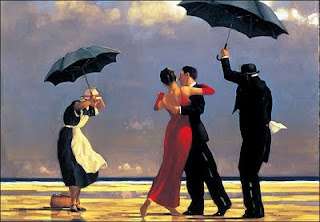
God knows I've been posting entries about originality and development of style for what seems a lifetime. I am not anywhere near coming to an opinion, either concrete or phenomenological. But the ideas for examining these questions often come to us from the most unexpected places. I was raking my front yard the other day in the middle of that day and noticed my neighbors' "For Sale" sign gone. A little later, a truck pulled in backwards into their driveway and they began to fill it up. My dear neighbors are gone, I thought. Their labor continued for most of the day. I spied as little as possible, thinking it rude to simply stare. Frankly, I was just sad. Suddenly, the movers carefully loaded Jack Vettrinano's "The Signing Butler" in the cavity of the large truck. You know the painting; it is available in most furniture stores and also in major department stores such as Target and even Walmart. I don't write this in order to bash Vettrianos' masterpiece; I rather like the work myself. But I remember an overly opinionated art appreciation professor I had in my sophomore year in college (gheez, how many years ago) who considered "The Singing Butler" little more than kitsch art. To my amateurish view, that's just downright an ugly statement. Do a search of Jack Vettriano's art and you'll see that this man had a talent that was not kitsch at all, but rather a beautiful self style that echoed with the style of a Master: Edward Hopper. I am certain that I am not the first, nor will be the last to make this connection. Again, do a search and you will see that there are plenty of people willing to label Vettriano a "Hopper wannabe." To me it is the other way around. I suspect that I am being innocent about this, but I think the parallels between the two artists was more the case of one artist absorbing the style of the older, wiser artist and developing a style of his own by means of incorporation. Certainly, the styles are similar in terms of round lines and soft edging, but there is a quality to Vettriano's art that Hopper simply lacks. I cannot post all of the illustrations here to make my point, but the two examples offered here were chosen for a reason. First, the similarities are clear--I've said that--but one thing absent in Hopper is the fullness of movement; the representation of wind, movement and the angular capturing of nature. To be sure, Hopper couldn't possibly do this while depicting his subjects in urban scenes that often turned desolate and lonely; many consider his subjects prisoners of modernity. There are, to be sure, plenty of Hopper paintings (especially his series of residences in Cape Cod) that incorporate elements of nature, but for the most part we know Hopper for his statements of isolation of the individual; the human subject often trapped in rooms with a single window offering the world outside as if in temptation. Vettriano does the same, but places the subject outside the confines of urbanity and reveals nature.
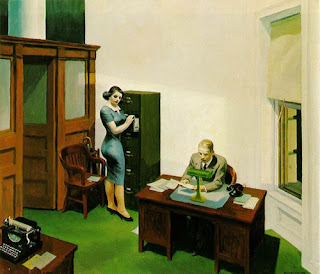
Going back to the idea of color, angular projection and round lines, Hopper and Vettriano are so similar one could easily confuse one for the other. I believe that whether or not Vettriano aimed to make it so (even if he hadn't ever heard of Edward Hopper), he successfully developed an original style from that of Hopper. The absence of facial expression is also a great difference between the two masters. Nevertheless, the two styles blend so closely one has to consider them both original on their own terms.

Good heavens... I've forgotten to write about finishing up "The Diaries of Christopher Isherwood 1939-1960" and how long it took me to cross the ocean of 900 pages. But I feel I have gained new friends in a way, such a tender and tumultuous artistic life; both his and that of Don Bachardy, his long-time partner. The diaries do not cover the later artistic recognition that Isherwood got in the seventies with the extravagance that was "Cabaret." You may recall on my earlier post about Isherwood that I mentioned Sally Bowles and "Cabaret" are based on stories by Isherwood, very early stories at that. At any rate, despite the fact that I disagree with Isherwood practically on everything, I enjoyed "meeting" him and also Bachardy. Here's a video documentary that talks about their relationship HERE. I really think that anything based on real love is a wonderful thing, and, while I don't follow the same emotional interest as Chris and Don, it is a tender story; one can easily grasp that by reading "The Diaries" or watching the documentary. Anything that is REAL LOVE between two people is a blessing... there's already too much hate in the world and anger and pain.

Labels: , , , , , ,

Tuesday, October 13, 2009

Lost in Place

I've lost so much in the last month that it is nearly incomprehensible to me how I've managed. In the same token, I now have time to finish several of my projects that I have been ignoring for the better part of two years. I've finished another Moleskine notebook, and I continue to write every day a minimum of two hours. The diaries of Christopher Isherwood are driving me insane, really, in a good way. I knew starting off that the task of reading this massive volume was going to be a tough going, but after 580 pages, and as I am starting to see the end of the tunnel, I feel rather prematurely nostalgic about what I am going to miss from reading this book. First of all, Isherwood's voice--it comes clean and loud through all of his writing (even the most mundane entries). Also, there's a great deal of detail about addresses of places he frequented; I am now one of those who "Google Earth" every address I find in any of the books I am reading. It's a sickness, I tell you, researching this so obsessively. I still have 400 pages to go, but I may have to put it aside and read some short fiction. All of this non-fiction reading has given me a metaphorical headache. And to think that I had proposed for next year to read only biographies! I better rethink that, pronto.

I am taking a short detour to re-read Alexander Solzhenitsyn's "One Day in the Life of Ivan Denisovich" because and simply because I want to. The weather has been terrible here for almost a month--cloudy and raining all of the time, with only sporadic cameo appearances by the sun that last less than 15 minutes. Solzhenitsyn's little masterpiece is as short as Isherwood's diaries are long, so I won't be away without an entry for as long as I have been lately.

I want to thank all of those who have sent me an electronic mail to wish me well. I have printed all (every single one) of those notes and I've placed them in a prominent place on my desk. Really, thank you from the bottom of my heart! I'll never forget all of your kindness.

Labels: , , ,

Friday, September 18, 2009

Literary Detours: Christopher Isherwood's Diaries

I find myself again and again lost in this massive volume. Isherwood's diaries are endless; one thinks of this man's habitual compulsion to write, and how we all now benefit from his insight in life, love, politics, and the Hollywood world. His insight into Vedanta and other Hindu mysticism is quire remarkable for the time he writes. Right now, "I am a Camera" has really taken off, and Isherwood, for probably the first time in his life, feels financially secure. How did these people live, I keep asking myself. Things have changed now, I suppose, but back then meaning you could depend on your friends was something far more significant than it is today.
The last installment of "Farewell to the Academy" might come this way even earlier than first anticipated. Who knows what will happen. These are very confused now, and I feel like I am living inside a Roque Dalton poem.

Labels: , ,

Tuesday, July 21, 2009

Literary Detours: The Diaries of Christopher Isherwood, Volume 001

I have no idea what prompted me to pick up this massive volume. Perhaps I was just due for a literary detour. "The Diaries of Christopher Isherwood, Volume One, 1939-1960" is full of literary gossip, but it is also an insightful look at the seminal moment of Hindu belief in America and its development from the ground up. Isherwood was among the many writers and actors in Hollywood to embrace Hinduism (Vedanta) back in the late 1930s and 1940s. It's amazing to see the quantity (and quality) of Isherwood's writing. This man wrote like every day was his last day on earth. If you are asking yourself, "where have I heard that name before?" you are not alone. Isherwood is the author of many novels and essays. His most memorable is "Berlin Stories" which was essentially turned into the musical "Cabaret." These diary entries are edited by Katherine Bucknell; she does an excellent job of keeping private those entries that might have revealed a bit too much of Isherwood's personal and intimate moments without losing the central idea of the man's genius. Sure, he was already in his mid forties and dating 19 year old young men, but who wasn't back in the Hollywood of those days. Isherwood was intensely frightful of war in general, so it came as no surprise that he took a conscientious objector status even before Pearl Harbor. Being a British subject at the time, he could have been called back home to fight. Luckily, that was not the case, and Isherwood spent the war years writing for MGM on a part-time basis, volunteering in a Quaker camp, and meditating the years away under the guidance of his guru, Swami Prabhavananda. Much is said regarding Aldous Huxley, Gerald Heard, Thomas Mann, Charlie Chaplin, Greta Garbo, W.H. Auden, among many, many others. I don't think Isherwood is just merely dropping names here; he's really got a handle on these people and depicts them clearly and with insight.

If you checked out the link you'll know that this is a 1,047 page chunkler. Somehow, I just found myself past page 300 within the first few days, and even though it is not part of my designated reading list books for 2009, I am going to press on and eventually finish it. The glossary, notes and other index goodies can't be past over without missing much. More on this later.

Finish the second of my "Writing" books. I read Ann Hood's "Creating Character Emotions." It was a very good and instructive book, but I think I often take advice on writing too literally, and eventually work myself into a corner with little options, so I have to learn how to moderate this.

I have a rant coming on "the American Short Story" and the genius that is Kevin Canty. Believe me, you will not want to miss that one.

Labels: , , ,