"Staying Up Too Late: Edward Hopper's Nighthawks and the Dark Side of the American Psyche" by Gordon Theisen
In 2008, I wrote a blog entry about Edward Hopper's "Nighthawks," the iconic painting of the late night diner and the characters inhabiting it. I wrote my entry mainly directed at the composition of the painting rather than its overall symbolic meaning. I've always felt lacking in my art appreciation skills; what little I can summon to make cross-examinations between literature and philosophy, I cannot translate to my interpretation of art. I am not sure why this is so, since I have been widely accused of having a "gift for gab" when it comes to academic topics. Nevertheless, I love visual art in all of its forms and writing about it here is a good exercise.
Back in 2008, when I was still within the safe confines of academia, a colleague found out I was writing an entry on "Nighthawks" and recommended a relatively "new" book on the matter. I did not go out and purchase the book right away, but I read some reviews online and made a note to find it and read it eventually. Fast forward to 2015... out of academia and slumming around used bookstores, I come across a hardcover copy of Gordon Theisen's "Staying Up Too Late: Edward Hopper's Nighthawks and the Dark Side of the American Psyche" for a mere $1. The book was heavily annotated by someone who had obviously enjoyed it, and I took that as a good sign. I found the book informative and passionately written. The volume occupies itself with its title subject, but also delves into the works and lives of many other artists--it also covers a variety of overlapping topics, a broad swat of ambitious intellectual composition. This, I respectfully believe, is what dooms parts of the book.
The introduction's pace is furious. Theisen writes intelligently about American culture, history and folkore. The problem stems from the fact that the author cannot conceal his politics (not that he is obligated to) and shows his bias a bit too forcefully. Some of this authoritative bias is understandable enough--it is his book, after all, but at times even the most subtle instances of it strike the reader as obnoxious. The fact that Hopper was "staunch Republican" strikes the author as odd, but it comes across as if Hopper, being an artist, was suffering from a type of intellectual or political leprosy. I think Theisen's interpretation here is unfounded. The so-called Republican Party "intolerance" of liberal arts, arts in general, etc. is a modern caricature conceived by pundits and political "experts." Back in the late 1920s and 1930s, the Republican Party was not the iconic intolerant, conservative, super-religious, backward organization it is represented as today. Both parties during the lifespan of Hopper's life had bigger "fishes to fry" other than engaging in petty "culture wars." The fact that Hopper grew up in a conservative household may have more to do with his reserved, painfully conservative politics and ideas, not simply the fact that he "carried the label" of the Republican Party. I am not defending a political ideology or even a party, but this type of what one can only assume to be "unintended bias" seems to have run its course during the Bush, Jr. years and now it sounds tiresome and only alienates those who see it for what it actually is.
I am sure Theisen did not set out to make it so, but the introduction is alarmingly depressing. His treatment of American optimism from a historical perspective also shows his bias. Our religious heritage has been damaging to American history; the Founding Fathers were blindly optimistic while ignoring the plight of non-white peoples; our economic system is based on optimism composed of thinly veiled lies, and so forth and on.
Once the book returns to the title subject, the core of its content is both entertaining and educational. Biographical details about Hopper are well-researched and presented here clearly, and the non-chronology meshes well with the analysis of Hopper's work. For the most part, the analysis of the art work is clear and informative; only in a few places does the language turn esoteric, and the analysis seems more like a stretch than insight.
I enjoyed the book tremendously. Perhaps my negative comments come from the fact that life outside academia is different; one doesn't have the luxury anymore to believe that analysis and interpretation "matter." Out here, a painting is just a painting and a late night diner just a late night diner.
Labels: Art and Literature, art history, Edward Hopper, Gordon Theisen, Nighthawks
posted by BookLoverMC @ 10:27 AM
0 comments

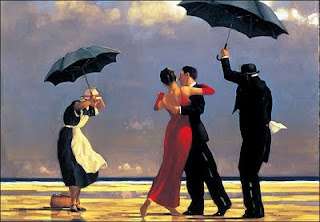 You know the painting; it is available in most furniture stores and also in major department stores such as Target and even Walmart. I don't write this in order to bash Vettrianos' masterpiece; I rather like the work myself. But I remember an overly opinionated art appreciation professor I had in my sophomore year in college (gheez, how many years ago) who considered "The Singing Butler" little more than
 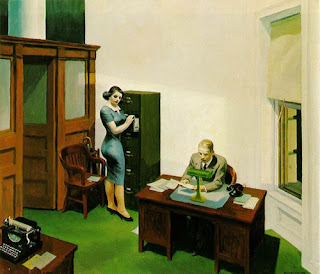 re plenty of people willing to label Vettriano a "Hopper wannabe." To me it is the other way around. I suspect that I am being innocent about this, but I think the parallels between the two artists was more the case of one artist absorbing the style of the older, wiser artist and developing a style of his own by means of incorporation. Certainly, the styles are similar in terms of round lines and soft edging, but there is a quality to Vettriano's art that Hopper simply lacks. I cannot post all of the illustrations here to make my point, but the two examples offered here were chosen for a reason. First, the similarities are clear--I've said that--but one thing absent in Hopper is the fullness of movement; the representation of wind, movement and the angular capturing of nature. To be sure, Hopper couldn't possibly do this while depicting his subjects in urban scenes that often turned desolate and lonely; many consider his subjects prisoners of modernity. There are, to be sure, plenty of Hopper paintings (especially his series of residences in Cape Cod) that incorporate elements of nature, but for the most part we know Hopper for his statements of isolation of the individual; the human subject often trapped in rooms with a single window offering the world outside as if in temptation. Vettriano does the same, but places the subject outside the confines of urbanity and reveals nature.
