On Originality of Style--The Eternal Debate
God knows I've been posting entries about originality and development of style for what seems a lifetime. I am not anywhere near coming to an opinion, either concrete or phenomenological. But the ideas for examining these questions often come to us from the most unexpected places. I was raking my front yard the other day in the middle of that day and noticed my neighbors' "For Sale" sign gone. A little later, a truck pulled in backwards into their driveway and they began to fill it up. My dear neighbors are gone, I thought. Their labor continued for most of the day. I spied as little as possible, thinking it rude to simply stare. Frankly, I was just sad. Suddenly, the movers carefully loaded Jack Vettrinano's "The Signing Butler" in the cavity of the large truck.
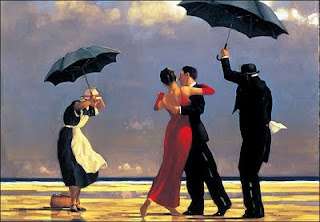 You know the painting; it is available in most furniture stores and also in major department stores such as Target and even Walmart. I don't write this in order to bash Vettrianos' masterpiece; I rather like the work myself. But I remember an overly opinionated art appreciation professor I had in my sophomore year in college (gheez, how many years ago) who considered "The Singing Butler" little more than kitsch art. To my amateurish view, that's just downright an ugly statement. Do a search of Jack Vettriano's art and you'll see that this man had a talent that was not kitsch at all, but rather a beautiful self style that echoed with the style of a Master: Edward Hopper. I am certain that I am not the first, nor will be the last to make this connection. Again, do a search and you will see that there a
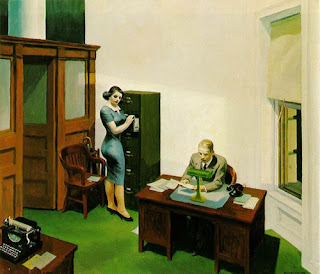 re plenty of people willing to label Vettriano a "Hopper wannabe." To me it is the other way around. I suspect that I am being innocent about this, but I think the parallels between the two artists was more the case of one artist absorbing the style of the older, wiser artist and developing a style of his own by means of incorporation. Certainly, the styles are similar in terms of round lines and soft edging, but there is a quality to Vettriano's art that Hopper simply lacks. I cannot post all of the illustrations here to make my point, but the two examples offered here were chosen for a reason. First, the similarities are clear--I've said that--but one thing absent in Hopper is the fullness of movement; the representation of wind, movement and the angular capturing of nature. To be sure, Hopper couldn't possibly do this while depicting his subjects in urban scenes that often turned desolate and lonely; many consider his subjects prisoners of modernity. There are, to be sure, plenty of Hopper paintings (especially his series of residences in Cape Cod) that incorporate elements of nature, but for the most part we know Hopper for his statements of isolation of the individual; the human subject often trapped in rooms with a single window offering the world outside as if in temptation. Vettriano does the same, but places the subject outside the confines of urbanity and reveals nature.
 Going back to the idea of color, angular projection and round lines, Hopper and Vettriano are so similar one could easily confuse one for the other. I believe that whether or not Vettriano aimed to make it so (even if he hadn't ever heard of Edward Hopper), he successfully developed an original style from that of Hopper. The absence of facial expression is also a great difference between the two masters. Nevertheless, the two styles blend so closely one has to consider them both original on their own terms.
Good heavens... I've forgotten to write about finishing up "The Diaries of Christopher Isherwood 1939-1960" and how long it took me to cross the ocean of 900 pages. But I feel I have gained new friends in a way, such a tender and tumultuous artistic life; both his and that of Don Bachardy, his long-time partner. The diaries do not cover the later artistic recognition that Isherwood got in the seventies with the extravagance that was "Cabaret." You may recall on my earlier post about Isherwood that I mentioned Sally Bowles and "Cabaret" are based on stories by Isherwood, very early stories at that. At any rate, despite the fact that I disagree with Isherwood practically on everything, I enjoyed "meeting" him and also Bachardy. Here's a video documentary that talks about their relationship HERE. I really think that anything based on real love is a wonderful thing, and, while I don't follow the same emotional interest as Chris and Don, it is a tender story; one can easily grasp that by reading "The Diaries" or watching the documentary. Anything that is REAL LOVE between two people is a blessing... there's already too much hate in the world and anger and pain.
Labels: Arts, Chris and Don, Christopher Isherwood, comparison, Don Bachardy, Edward Hopper, Jack Vettriano
posted by BookLoverMC @ 11:51 AM
2 comments


